Sunday, June 20, 2010

Children's Poetry Archive

I've recently come to adore the Children's Poetry Archive. I love how colorful it is and how easy the website is to navigate. You can search by poet, poem, theme, or even form. Other things I love are recordings of each poem, poet bios, links to other poetry sites, lists of publishers,  and links to buy CD's and books of the poetry. My only complaint is the limited number of poets included on the site, which excludes many of my childhood favorites. Still it's definitely worth a look, particularly if you, dear reader, have small children you want to lure into the world of poetry, or if you yourself wish to be lured.


Friday, June 18, 2010

Drifted Away

The human memory has always been intriguing to me. I am one who scrawls away in journal after journal, taking pictures of each day, haunted by all that there is ahead of me to be forgotten. And yet, a thousand words and a hundred pictures can only freeze the memory on paper, and not in the mind. Just today, I remembered having forgotten the name of a boy I was once friends with, and the word for "mother" in sign language. What of all that I don't even recall having forgotten? I love Billy Collin's poem on the topic of forgetting, particularly this unique portrayal of it.

Saturday, May 29, 2010

This Little World To-night

Dear reader,

I apologize for my lack of recent posts. It isn't as though I have been busy. I've had scads of time on my hands. Doesn't it always seem to be the case that the more free time you have the less that gets done?

Last night I took off on a whim to a favorite spot of mine. I had with me the essentials: a camera, a book of poetry, and a notebook and pen. I spent a delicious stretch of time with William R. Bowlin's 1939 anthology, A Book of Treasured Poems. Generally, such anthologies dole out poems rife with predictable rhyme endings, heavy with trite morals. I am not a particular fan of such poems. Fortunately, A Book of Treasured Poems held some beautiful gems in the mix. Today, I'll share with you Oliver Herford's "Earth," a curious little poem that doesn't seem to want to shake itself from my thoughts. But first, let me share with you a small excerpt I loved of the anthology's "Foreword," as written by William R. Bowlin:
The absence of formal notes in this little volume is not the result of inertia or of oversight, but of an attempt by the editor to remove poetry from the realm of pure intellect and restore it to the field of emotion. Intensive study of poetry leads, all too often, to dislike of poetic expression rather than to its enjoyment. Poetry is an end in itself, and the awakening of love for a fine poem is the sole aim in teaching the poem. 


And now, Herford's "Earth."
Earth 
Oliver Herford
(As printed in A Book of Treasured Poems)

If this little world to-night
     Suddenly should fall through space
In a hissing, headlong flight,
     Shrivelling from off its face,
As it falls into the sun,
     In an instant every trace
Of the little crawling things--
     Ants, philosophers, and lice,
Cattle, cockroaches, and kings,
     Beggars, millionaires, and mice,
Men and maggots all as one
As it falls into the sun...
Who can say but at the same
     Instant from some planet far
A child may watch us and exclaim:
     "See the pretty shooting star!"
To be posted soon: Reviews of recently read books, quotes on poetry, and more beautiful poetry of the world.

Tuesday, April 27, 2010

The Crying is Lonely

I've had this poem and its characters on my mind a while now...
A Couple
Carl Sandberg

He was in Cincinnati, she in Burlington.
He was in a gang of Postal Telegraph lineman.
She was a pot rassler in a boarding house.
“The crying is lonely,” she wrote him.
“The same here,” he answered.
The winter went by and he came back and they married
And he went away again where rainstorms knocked down
telegraph poles and wires dropped with frozen sleet.
And again she wrote him, “The crying is lonely.”
And again he answered, “The same here.”
Their five children are in public schools.
He votes the Republican ticket and is a taxpayer.
They are known among those who know them
As honest American citizens living honest lives.
Many things that bother other people never bother them,
They have their five children and they are a couple,
A pair of birds that call to each other and satisfy.
As sure as he goes away she writes him, “The crying is lonely”
And he flashes back the old answer, “The same here.”
It is a long time since he was a gang lineman at Cincinnati
And she was a pot rassler in a Burlington boarding house;
Yet they never get tired of each other; they are a couple.

Monday, March 29, 2010

1968, Honolulu, and Anne Sexton

Amidst the jumbled shelves of a thrift shop, I recently stumbled upon the 1968 Reading Modern Poetry. An address label was slapped upon the cover, the address, I assume, of the previous owner, Lydia of Honolulu. How, I wonder, did this anthology cross the ocean and decades between Lydia and I? 


Based upon the markings within the book, I gather Lydia purchased it for a class. Next to the listing of poems in the table of contents are scrawled days of the week, "Wednesday," and "Friday." Some poems have checks next to them. There are impersonal, predictable annotations penned alongside the poems of W.B. Yeats, T.S. Eliot, Gerard Manley Hopkins, and Theodore Roethke. Were it just for these markings, Lydia could be anyone. Yet, Lydia gives herself away by starring and underlining the name of Anne Sexton. Similarly she has starred the two anthologized Sexton poems, "The Addict," and "Cripples and Other Stories." Why, out of the fifty-something poets in the collection, is Sexton the only one Lydia found worthy of both starring and underlining? What is it about Sexton's dark madness that appealed to my anonymous fellow reader? Lydia, are you out there?

I loved Sexton's "Cripples and Other Stories," but as it is rather long, I'll instead offer you up a shorter poem, "Red Roses." It is much in line with Theodore Roethke's "My Papa's Waltz," though I like the Sexton poem without liking the Roethke. 
Red Roses
Anne Sexton 

Tommy is three and when he’s bad
his mother dances with him.
She puts on the record,
“Red Roses for a Blue Lady”
and throws him across the room.
Mind you,
she never laid a hand on him.
He gets red roses in different places,
the head, that time he was as sleepy as a river,
the back, that time he was a broken scarecrow,
the arm like a diamond had bitten it,
the leg, twisted like a licorice stick,
all the dance they did together,
Blue Lady and Tommy.
You fell, she said, just remember you fell.
I fell, is all he told the doctors
in the big hospital. A nice lady came
and asked him questions but because
he didn’t want to be sent away he said, I fell.
He never said anything else although he could talk fine.
He never told about the music
or how she’d sing and shout
holding him up and throwing him.
He pretends he is her ball.
He tries to fold up and bounce
but he squashes like fruit.
For he loves Blue Lady and the spots
of red roses he gives her.

Saturday, March 6, 2010

Typography Meets Poetry

Today, I'd like to share with you what happens when typography meets poetry.

First, an amazing typographic interpretation of a favorite poem of mine, Walt Whitman's "When I Heard the Learn'd Astronomer."


Next up, the poem "Minimalism," that, as far as I can tell is written by Jeff Smith-Luedke.


Like what you see? Check out more on YouTube.

Sunday, February 28, 2010

Gravely Poetic

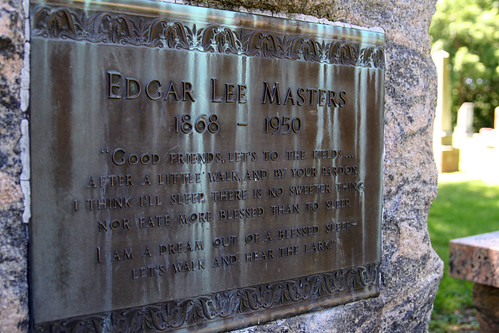
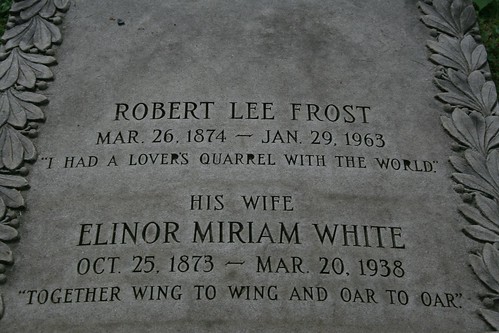
 The other day, in conversation with roommates, the topic of favorite poems came up. My roommate, Hillary, pulled up the following picture as her favorite poem:


 She then proceeded to share her experience of visiting Hemingway's grave every fall and how perfectly the poem encapsulated.

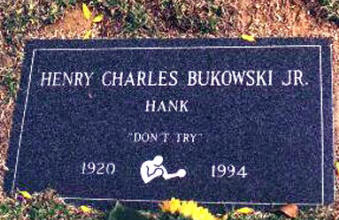
I love this idea of poetic epitaphs. One of my favorite's is the words upon Keat's grave.
In searching poetic gravestones, I was delighted to stumble upon the website, Poets' Graves. Call me a nut job, but I think a roadtrip of famous cemetery's and grave sites would be awesome.


Have any favorite epitaphs to share?

Wednesday, February 24, 2010

Simply Because You Asked

Tonight, I am in love with this gem, as found in Billy Collins' 180 More. Please, enjoy.

“The Russian Greatcoat” 
Theodore Deppe
 
While my children swim off the breakwater,
while my wife sleeps beside me in the sun,
I recall how you once said you knew
a sure way to paradise or hell.
Years ago, you stood on the Covington bridge,
demanded I throw my coat into the Ohio--
my five dollar “Russian greatcoat,”
my “Dostoevsky coat,” with no explanations,
simply because you asked.

From that height, the man-sized coat fell
in slow motion, floated briefly,
one sinking arm bent at the elbow.
At first, I evade the question when my wife asks,
as if just thinking of you were an act of betrayal.
The cigarette I shared with you above the river.
Our entrance into the city, your thin black coat
around both our shoulders. Sometimes I can go
weeks without remembering. 

Friday, February 19, 2010

Pages of Rain

I love L-O-V-E as much as the next person, but two weeks of L-O-V-E poems was a bit much. Lesson learned: Never celebrate the month of L-O-V-E in such a manner ever again. Thank goodness, dear reader, we can now move onward. 

What poetry I've recently read or I am currently reading:
  • Eireann Corrigan's poetic memoir, You Remind me of You. It is the story of Corrigan's struggle with anorexia, her relationship with her boyfriend, and his struggles with depression. Upon first read, I loved it. The book combines three loves of mine: poetry, memoirs, and young adult literature. It was a gorgeous, fast, emotional read. But, the more I come back to it, the less impressed I am. Corrigan over-uses shock value. Her writing is occasionally heavy handed and her attempts at irony often fall flat. Crucial events are rehashed half a dozen times throughout the book. I applaud Corrigan for what she has overcome and the work she has produced, but it is not a work I'd recommend for more than a quick read.
  • Billy Collins' 180 More Extraordinary Poems for Every Day. There seems to be this cult of lovers of Billy Collins. I do not want to join the following, because I'm stubborn like that. But dang, I'd have to admit the man is terrific. I own a copy of Collins' anthology Poetry 180: A Turning Back to Poetry and I love it. It's just such a fun collection. While I have not yet had the time to really familiarize myself with 180 More, my initial impression is one of full approval. I must give a nod to Collins for spreading accessible poetry across America. 
  • Ted Kooser's Delights and Shadows, winner of the Pulitzer Prize for Poetry. To be fair to Mr. Kooser, I will refrain from commentary on the work as a whole until I have finished it. But tonight, I'd like to share with you one poem of Kooser's that I just love. 

A Rainy Morning
Ted Kooser

A young woman in a wheelchair,
wearing a black nylon poncho spattered with rain,
is pushing herself through the morning.
You have seen how pianists
sometimes bend forward to strike the keys,
then lift their hands, draw back to rest,
then lean again to strike just as the chord fades.
Such is the way this woman
strikes at the wheels, then lifts her long white fingers,
letting them float, then bends again to strike
just as the chair slows, as if into a silence.
So expertly she plays the chords
of this difficult music she has mastered,
her wet face beautiful in its concentration,
while the wind turns the pages of rain.

Saturday, February 13, 2010

Valentine's Day 2010

Happy Valentine's Day, dear reader.
Here is a chaotic mess of love quotes, links, and poems.
Enjoy what you'd like to, ignore what you don't.


"I heard what you said. I’m not the silly romantic you think. I don’t want the heavens or the shooting stars. I don’t want gemstones or gold. I have those things already. I want…a steady hand. A kind soul. I want to fall asleep, and wake, knowing my heart is safe. I want to love, and be loved."
~ Shana Abé
Those Who Love
Sara Teasdale
Those who love the most,
Do not talk of their love,
Francesca, Guinevere,
Deirdre, Iseult, Heloise,
In the fragrant gardens of heaven
Are silent, or speak if at all
Of fragile inconsequent things.

And a woman I used to know
Who loved one man from her youth,
Against the strength of the fates
Fighting in somber pride
Never spoke of this thing,
But hearing his name by chance,
A light would pass over her face.

"I, with a deeper instinct, choose a man who compels my strength, who makes enormous demands on me, who does not doubt my courage or my toughness, who does not believe me naïve or innocent, who has the courage to treat me like a woman."
~ Anaïs Nin

Check out the July 3, 2008 post, Crazy Little Thing called Love, for more love quotes.
Sometimes with One I Love
Walt Whitman

Sometimes with one I love, I fill myself with rage, for fear I effuse unreturn’d love;
But now I think there is no unreturn’d love—the pay is certain, one way or another;
(I loved a certain person ardently, and my love was not return’d;
Yet out of that, I have written these songs.)
Love love poetry? Check out the works of John Donne here, love poems among others.

"I do not want to be the leader. I refuse to be the leader. I want to live darkly and richly in my femaleness. I want a man lying over me, always over me. His will, his pleasure, his desire, his life, his work, his sexuality the touchstone, the command, my pivot. I don’t mind working, holding my ground intellectually, artistically; but as a woman, oh, --- , as a woman I want to be dominated. I don’t mind being told to stand on my own feet, not to cling, be all that I am capable of doing, but I am going to be pursued, ------, possessed by the will of a male at his time, his bidding."
~ Anaïs Nin

Photo by: Valerie Owens. Please do not use without permission.

Click here for a favorite love quote of mine, orignally posted in June 2008.

"There are three possible parts to a date, of which at least two must be offered: entertainment, food, and affection. It is customary to begin a series of dates with a great deal of entertainment, a moderate amount of food, and the merest suggestion of affection. As the amount of affection increases, the entertainment can be reduced proportionately. When the affection IS the entertainment, we no longer call it dating. Under no circumstances can the food be omitted."
~ Judith Martin


True Love
Judith Viorst

It is true love because
I put on eyeliner and a concerto and make pungent observations about the great issues of the day
Even when there's no one here but him,
And because
I do not resent watching the Green Bay Packers
Even though I am philosophically opposed to football,
And because
When he is late for dinner and I know he must be either having an affair or lying dead in the middle of the street,
I always hope he's dead.

It's true love because
If he said quit drinking martinis but I kept drinking them and the next morning I couldn't get out of bed,
He wouldn't tell me he told me,
And because
He is willing to wear unironed undershorts
Out of respect for the fact that I am philosophically opposed to ironing,
And because
If his mother was drowning and I was drowning and he had to choose one of us to save,
He says he'd save me.

It's true love because
When he went to San Francisco on business while I had to stay home with the painters and the exterminator and the baby who was getting the chicken pox,
He understood why I hated him,
And because
When I said that playing the stock market was juvenile and irresponsible and then the stock I wouldn't let him buy went up twenty-six points,
I understood why he hated me,
And because
Despite cigarette cough, tooth decay, acid indigestion, dandruff, and other features of married life that tend to dampen the fires of passion,
We still feel something
We can call
True love.

Check out the L-O-V-E label for more love poetry, both recent and past posts.

"I am only responsible for my own heart, you offered yours up for the smashing my darling. Only a fool would give out such a vital organ"
~ Anaïs Nin
Love Poem With Toast
Miller Williams

Some of what we do, we do
to make things happen,
the alarm to wake us up, the coffee to perc,
the car to start.

The rest of what we do, we do
trying to keep something from doing something,
the skin from aging, the hoe from rusting,
the truth from getting out.

With yes and no like the poles of a battery
powering our passage through the days,
we move, as we call it, forward,
wanting to be wanted,
wanting not to lose the rain forest,
wanting the water to boil,
wanting not to have cancer,
wanting to be home by dark,
wanting not to run out of gas,

as each of us wants the other
watching at the end,
as both want not to leave the other alone,
as wanting to love beyond this meat and bone,
we gaze across breakfast and pretend.